First War of the Hoard
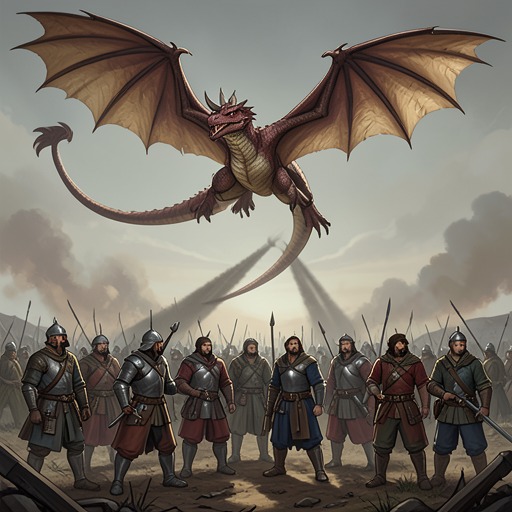
Vainqueur the DragonThe First War of the Hoard is the conflict in which Vainqueur Knightsbane slew the lich Furibon and reclaimed the treasure he regarded as the defining substance of his existence. Its importance extends beyond the battle itself: Vainqueur later presents the victory as proof that he is the Defender of the Hoard, uses it to justify rule over Ishfania, and turns Furibon’s defeat into a recurring public ritual of imperial celebration.
Causes and Background
The war arose from Furibon’s control of wealth and territory that Vainqueur Knightsbane considered properly part of his hoard. Furibon was not merely a rival claimant but a cruel undead ruler whose influence reached the gnoll tribes south of Vainqueur’s domain. Those tribes were permitted to live and retain their gold only so long as they obeyed Furibon, and many fled when Vainqueur began his war against the lich. The conflict therefore combined a private dragon’s obsession with possession, a struggle against an oppressive overlord, and the wider displacement of communities living under Furibon’s authority.
The landscape surrounding the later Castle of Murmurin shows what was at stake. The castle stood beside a large volcano and the western sea, while the surrounding badlands, sparse vegetation, arroyos, and immense red desert offered little prosperity. Vainqueur nonetheless saw the fortress as an ideal place to store his hoard. The region’s settlements, encampments, surviving inhabitants, and buried or accumulated wealth made control of the territory inseparable from control of its resources.
The deeper history of the territory also gives the war an imperial dimension. Allison explained that the Sablaris had once ruled much of the southern continent, Ishfania, and Barin before cultists of Sablar the destroyer caused a magical cataclysm that converted their empire into a red desert. Afterward, Brandon Maure seized the ruins of Ishfania with summoned monsters. Furibon’s local rule thus belonged to a landscape already marked by conquest, catastrophe, and competing claims to abandoned wealth. Vainqueur’s war did not restore an old order; it opened the way for another claimant to define the ruins as his own realm.
Course and Victory
The available account identifies the decisive outcome rather than giving a complete battlefield chronology: Vainqueur Knightsbane slew Furibon during the First War of the Hoard. The victory removed the dread lich from power and released the surviving gnolls from the arrangement that had allowed them to remain in the region only under Furibon’s domination. Some of those gnolls later came to Murmurin seeking work. Vainqueur condemned them for having knowingly served a cruel undead ruler, but then forgave them and accepted them into his service.
That acceptance did not make the postwar settlement peaceful. The gnolls proved lazy and cowardly in comparison with Vainqueur’s zealous Kobold Rangers. They stopped working whenever Vainqueur was not watching and fought among themselves, forcing the dragon to eat twenty troublemakers before the rest began to obey. The episode shows how the war’s victory created a labor and governance problem as well as a triumph: defeating Furibon gave Vainqueur subjects and territory, but maintaining the new order required coercion, recruitment, and the conversion of former dependents into imperial minions.
The war’s material result was concentrated in the hoard. Vainqueur treated treasure as both the cause of the conflict and the measure of its success. Even when he loaned weapons to his minions, he disliked spreading his hoard beyond his sight. He permitted Victor Dalton to wield his sacred treasures because Victor was the only servant he fully trusted not to lose them, while Barnabas was instructed to manufacture weapons for the minions. The arrangement reveals the lasting logic of the First War: treasure could be deployed for conquest, but possession remained the governing principle.
Political and Personal Consequences
The victory became the central credential in Vainqueur’s later public self-definition. When he adopted the adventurer identity, he rejected the suggestion that he had become a banker and instead called himself the Defender of the Hoard. He cited two victories as the basis of that title: he had slain Furibon in the First War of the Hoard and later defeated the Moth King in the Second War of the Hoard. He also claimed that he had uncovered the ancient dragon system, gaining the power and money needed to protect the dragon way of life from forces that would reduce it to lead.
The First War consequently changed the meaning of Vainqueur’s hoard. It was no longer presented only as a private accumulation guarded by a solitary dragon. Vainqueur described himself as defending all hoards, including those of weak and fragile manlings who paid tribute and entrusted their wealth to him. The boast simultaneously magnified his authority and recast acquisition as public protection. His imperial identity depended on this contradiction: he demanded treasure as tribute, yet represented the demand as the service of a universal guardian.
The war also helped create the legal foundation for Vainqueur’s rule over Ishfania. After Brandon Maure’s death and the destruction of his army, the region ceased to exist as a nation, though its resources remained valuable enough to attract the Eversun Empire, Barin, and Prydain. Roland Gardemagne proposed a treaty recognizing Vainqueur as Emperor of Ishfania and treating his territory as an official adventurer state. In return, Vainqueur would vow that Gardemagne and his realm would never take arms against one another and would unite against outside threats. The settlement converted military possession into recognized sovereignty and protected Vainqueur’s access to his Emperor class.
Memory, Ritual, and Retelling
Vainqueur repeatedly turns Furibon’s defeat into a story about his own greatness. After becoming Emperor, he declared an annual Vainqueur Day to celebrate Furibon’s destruction. The festival was to include a great feast of cattle and the burning of a wooden puppet of Furibon before an adoring crowd. Vainqueur also wanted a statue of himself built in the werewolf village, larger than the statues of the gods in human temples. The proposed ceremony therefore joins historical remembrance to spectacle, appetite, monumental self-praise, and the public training of subjects to admire the victor.
The ritual is not confined to Vainqueur’s private memory. Pink, a Kobold Ranger who writes about the imperial past, described the later Event as so traumatizing that she needed alcohol before she could commit the account to paper. Red answered that everyone knew how traumatizing the Event had been and urged the minions to train so that such senseless atrocity could never happen again. Although this testimony does not supply a full narrative of the battle, it establishes that the war and its associated violence survive as collective trauma as well as imperial legend.
The contrast between the two forms of remembrance is central to the event’s significance. Vainqueur imagines a cheering audience, a feast, a burning effigy, and a monument to his own magnificence. The Kobold Rangers’ later rehearsal culture remembers catastrophe, discipline, and the need to prevent recurrence. The First War of the Hoard thus exists simultaneously as a founder’s victory and as a wound inherited by the minions who serve the order it created.
Narrative Significance
Within Vainqueur Knightsbane’s history, the First War of the Hoard is the first major victory to become a reusable political myth. It supplies the language for his title as Defender of the Hoard, distinguishes him from ordinary bankers or adventurers, and helps turn a dragon’s possessiveness into an ideology of protection. Its effects extend through recruitment, settlement, tribute, weapon lending, imperial ceremony, and diplomatic recognition.
The event also establishes a recurring exchange between violence and legitimacy. Vainqueur defeats Furibon, acquires the authority to redistribute or guard wealth, absorbs displaced populations into his service, and later receives recognition as Emperor of Ishfania through treaty. The war’s immediate logic is conquest, but its enduring narrative function is state formation. By the time the victory is celebrated as an annual holiday and invoked alongside the defeat of the Moth King, the battle has become less a discrete military episode than the founding proof of Vainqueur’s claim that treasure, power, and rule naturally belong together.